NOTE: This post originally appeared at the now-defunt PencilThings blog on July 9, 2007. See it, sans CSS or images, at the Internet Archive here.
 I first discovered this wonderful little orange notebook back in 2003 when I was watching one of my favorite shows, Good Eats. The host, Alton Brown, was writing a grocery list on a Rhodia notepad. It didn’t process with me, until a year later when I attended college at Indiana University in Bloomington, IN. There is a great little store there called T.I.S. that sells textbooks, college apparel, and office supplies. Yes, office supplies! A veritable plethora of pens, pencils, and paper.
One shelf had a shoddy little orange display. Though it was in disrepair, the orange-ness and the stylized European look lent itself to hipness and—what immediately attracts me to almost any consumer product—cult following. That episode of Good Eats sprung into my mind, and I realized: if my hero Alton Brown has one, by gum—I need one too.
Fallacious though my reasoning was, it was one of the best purchases I ever made. Yeah, it is cool looking. (Aesthetics count for a lot, just read some of my pencil reviews.) The bright orange and the crisp black go so well together, you don’t even think of a Halloween theme. Immediately upon opening the cover, you know you’ve reached notepad nirvana. The satin-finished paper is think, luscious, and smooth. If writing on a standard notepad is like driving down the street, writing on Rhodia paper is like cruising in your hovercraft across a giant swimming pool. On a calm day. Take a look at the paper:
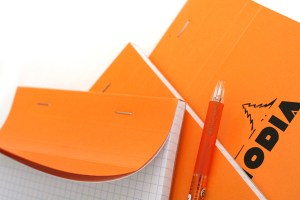
Isn’t that nice? (The image is not mine.)
Notice that both pictures feature graph paper in their notebooks. Chill out, man, that’s the way the Europeans do it. I personally like it. That way, you can write with the notebook turned portrait or landscape. For your American purists out there, they do come in lined versions.
I can even tell you what my favorite size is—the 3″ x 8.25″. It is extremely long and skinny and fits in the palm of your hand really well. Perfect for making lists and, if you are a reporter, taking notes on the go. I spent some time working for a newspaper and this was my best friend.
Unfortunately, yes—Rhodia is expensive. An 8.5″x11″ pad with 80 sheets will cost you about $9, as opposed to less than a dollar you might spend on a Mead notebook from Target. But it is worth it. Trust me.
Find Rhodia notepads at Pencil Things and many other fine stationary retailers. Also, one of my favorite blogs, Rhodia Drive, is devoted to their full line of products.
Overall rating: 4.5 out of 5 points.
UPDATE 09/27/10: I’ve been using Rhodia notepads every day since then. Often when I review a pencil, it provides a white background on which I base the blackness of the graphite. I have discovered, as John from Pencil Revolution mentions in his review of Field Notes, that for some pencils, the creamy, smooth paper of Exaclair products sometimes doesn’t “catch” the graphite as well as something more fibrous, like Field Notes. But for high-end pencils and—gasp—ink pens, Rhodia is king in smoothness, bleedlessness (which I’m pretty sure isn’t a word), and quality.


 The Powers That Be over at

 Woodclinched