Review: The Monteverde One Touch Stylus Tool Mechanical Pencil

Folks, I’m a sell-out.

This blog is about wooden pencils; in fact, “wood” is right there in the name. I’ve always eschewed mechanical pencils, an in fact, have often linked to my favorite chapter, in full, of David Rees’s book, How to Sharpen Pencils.

So what I’m about to tell you may come as a shock:

You’re about to read a review of a mechanical pencil.

After you recover from that blow, I’ll give you a bit of a background. Ron from Pen Chalet contacted me a few months ago asking if I’d like to review anything from his shop. I’ve always admired his selection of high-end pens (Where else could I buy a $30,000 fountain pen?) but I knew that I couldn’t justify acquiring a fancy fountain pen for review on a pencil blog. I don’t have the vocabulary or the breadth of knowledge about pens to give it a fair review — I leave that to the likes of Brad or Ed or any of the other great pen bloggers out there.

But in the mechanical pencil section — there was one that I had my eye on:

monteverde-profile

Have you ever seen such a thing? I haven’t. I was familiar with Monteverde previously, but I don’t think I’ve ever used one of their products. This looks super cool — from the bright yellow hexagonal shape (almost like a wooden pencil!) to the ruled hashes on the side, to the capacitive stylus on the end. This looks like something Alton Brown would carry, or maybe Tommy Silva from This Old House.

Features

I was disappointed to note that the mechanical pencil doesn’t have the bubble level function in the side — that comes only with the fountain pen and the ballpoint. I think the mechanism that pushes the graphite up and down took up too much room.

But some of the other functions more than made up for it. The barrel features three different units of measurement — inches, 1:100 meters, 1:200 meters, and 1:300 meters.

The top opposite end of the barrel (where the eraser would be on a wooden pencil) has a really nice capacitive touch stylus that’s pretty sensitive. I could do some detailed sketching on my iPhone with it. I admit I don’t use a stylus very often, but when I do, this is a perfect one to use.

monteverde-mechanical-pencil-stylus-closeup

I knew there was an eraser somewhere on this device, but I didn’t know where! Ah! I realized. This stylus unscrews! I turned it counter-clockwise unit it popped off, and there I found…
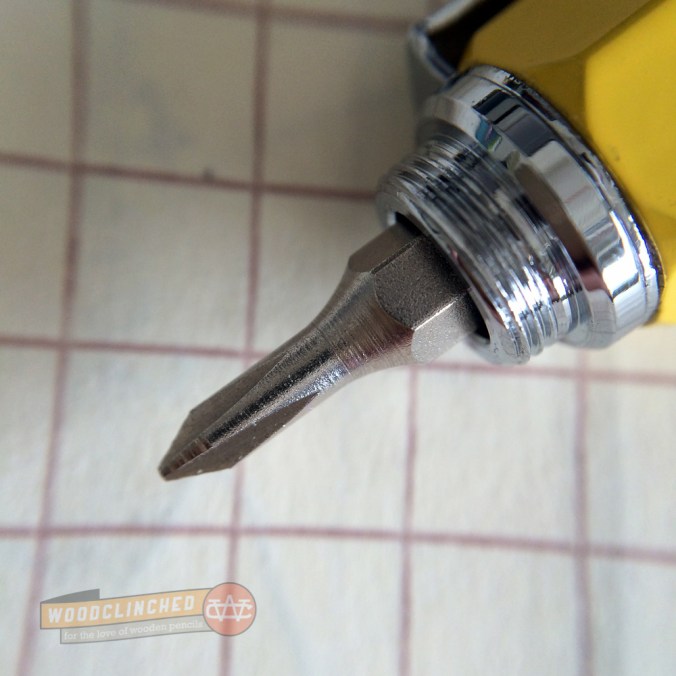
monteverde-mechanical-pencil-screwdriver-closeup

…a tiny screwdriver? That’s awesome. The bit pops out and is reversible, so you can work with Phillips and with flat head screws. It’s a bit too tiny to work with screws on, say, a piece of furniture, but just right for precision work — perfect for tightening screws on my eyeglasses or a hand-held electronic device.

monteverde-mechanical-pencil-screwdriver-with-glasses

I knew that somewhere — somewhere! — there was an eraser. A coworker and I played around with it, trying to find it. Finally, we pulled on the end where the graphite comes out, and there it was!

monteverde-mechanical-pencil-broken-down

Like most high-end mechanical pencils, it’s almost useless. I don’t know if they think those who use fancy mechanical pencils don’t need to erase with any frequency, or what, but I knew that between its stature and its accessibility, I’d continue to use a handheld eraser when using this pencil.

Aesthetics

As soon as it arrived at my door, I was excited. The package has a nice heft to it — something I’ll admit wooden pencils can’t replicate. I knew I was holding a solidly machined piece of metal, heavy but compact — like a MacBook or an iPhone.

The one drawback to the feel of it is intrinsic with any mechanical pencil with loose leads floating around inside: it rattles. Unlike a pen or a wooden pencil, if you move it around a bit, you can hear and feel that lead inside. But this is something I realize can’t be helped.

monteverde-mechanical-pencil-detailing

As I mentioned before, the yellow, hex barrel reminds me of a wooden pencil. Otherwise, that’s where it stops. There is handsome brushed aluminum on either end of the barrel; acting as the “ferrule” for the stylus, and providing a grip on the tip. The pocket clip is a shiny stainless.

Performance

Here’s the to-do list I wrote in order to measure the performance of this pencil:

monteverde-mechanical-pencil-writing

This has been the hardest part of the review, just because I’m unsure of myself. I lack the breadth of experience to even compare this to other mechanicals — when I do use one, it’s a cheap disposable pencil like my favorite, the Zebra #2, which doesn’t compare at all to this. I even lack the vocabulary — what do you call the mechanism that draws the graphite core down? How do you grade the graphite refills? I have no idea.

Finally, I just decided to grin and bear it, and just honestly speak of my experience.

First of all, it took some getting used to when extending the graphite. If I drew it down too far, it got loose and when I pressed down, it would recede slightly back up into the pencil.

For the life of me, I couldn’t figure out how to explain that without making a GIF. And I do love me some GIFs. I found a fantastic little app to do just that:

monteverde_mechanical_pencil_tip

Besides that detail, the parts that makes this mechanical pencil “mechanical” are excellent. The bits that turn and screw/unscrew turn smoothly. The parts that are held in by tension hold fast, and pop out with a pretty easy yank.

The other drawback, for me and my way of writing, is that the graphite core is so thick! It uses a 0.9mm refill, which is roughly the thickness of a moderately dull wooden pencil. I generally prefer a 0.7mm core, which is what, say, the aforementioned Zebra #2 uses. I’ve been known to use a 0.5mm lead, but that is generally too thin and I break it if I press down with my normal amount of pressure.

The tip of the Monteverde mechanical pencil, top, compared to the tip of a Palomino Blackwing Classic, freshly sharpened in a Classroom-Friendly pencil sharpener.

The tip of the Monteverde mechanical pencil, top, compared to the tip of a Palomino Blackwing Classic, freshly sharpened in a Classroom-Friendly pencil sharpener.

Here’s where I get confused when writing about mechanical pencils: reviewing the quality of the graphite. With wooden pencils and the baked-in core, I know that the graphite is (or should be) of a consistent quality. With mechanical pencils, where the core is divorced from the production of the barrel, how do I review it?

In any case, despite the thickness of the core, it writes silky smooth. It feels much softer and darker than a standard HB lead — I’d put this at a 3B or even a 4B. It’s not great for how hard I press; I turn the tip to advance more lead before I even reach the end of a line, sometimes.

The graphite erases like a champ, though, very cleanly considering how dark it is.

I’d venture a guess and say that this graphite is optimized for those making notations in a shop, on wood or ceramic or something. Like a Palomino Classic, it’d be great for sketching and drawing, but maybe not for writing.

In brief

This is a unique, interesting concept that’s well-executed for what it needs to do. It’s well-manufactured and much attention has been paid to the details.

On the other hand, the concept is odd; I’m not sure when I’ll need a mechanical pencil with a ruler (usually, I’d want to use the pencil alongside the ruler to make marks at the rule) along with a screwdriver along with a stylus, but if I do, this is the tool.

This pencil is not flavored for my particular pencil work-flow, which involved a lot of writing and note-taking. But for someone taking short, sketchy notes and annotations, especially against a different surface than notebook paper, it’d be fantastic.

The price, $40 (on sale lately for $32), is reasonable, especially considering how long this thing will last. This is definitely a multi-generational keeper.

As I said before, reviewing this thing has been a challenge but an interesting and enjoyable one. I don’t think I’ve become a fine mechanical pencil convert, but I have learned to notice and appreciate details that I’ve never really thought of before. When I use a mechanical pencil, I’m still planning on reaching for my Zebra #2, if only because of its utility, size and price. But this Monteverde will be a prized member of my collection of pencilnalia.

Where to buy

Check it out at Pen Chalet for $32. It’s available in silver and black as well, which are beautiful in their own right, but for me, bright yellow is the way to go.

UPDATE: Great minds must think alike! My friend and podcast co-host Johnny Gamber from Pencil Revolution posted a review of the same product, in the same color, on the same day! I won’t spoil his review, so go over and check it out.

Erasable Episode 6: The Brotherhood of the Traveling Sharpener

Reviewing materials for a podcast about pencils has never been so yellow!

Reviewing materials for a podcast about pencils has never been so yellow!

Tim, Johnny and I have been having a blast with the Erasable podcast so far. An absolute blast. Perhaps my favorite episode so far is the one that just came out today, Episode 6: The Brotherhood of the Traveling Sharpener.

Whenever we’ve asked Twitter for ideas on what our followers would like us to talk about, almost everyone wants to know about sharpeners. Trouble is, we’re just an hour(-ish) long podcast, and there are so many sharpeners out there!

We decided to just go through some questions people have asked, and then list our favorites and explain them, like the Classroom Friendly Sharpener and the much-debated KUM Long Point Sharpener. Invariably, the conversation came around to David Rees and his artisanal pencil sharpening, and, of course, his book.

Rees talks a lot about one of my sharpener obsessions; the El Casco, which I’ve blogged about before. It’s quite expensive, and Johnny proposed we all three pitch in to buy one and then share custody (like the pants from the movie The Sisterhood of the Traveling Pants. Hence the episode title).

Go take a listen — if you have any interest in pencils sharpeners at all (and why would you be here if you didn’t?), you’ll love it.

The Baron Fig Confidant notebook: Unique, well-constructed, and well-hyped

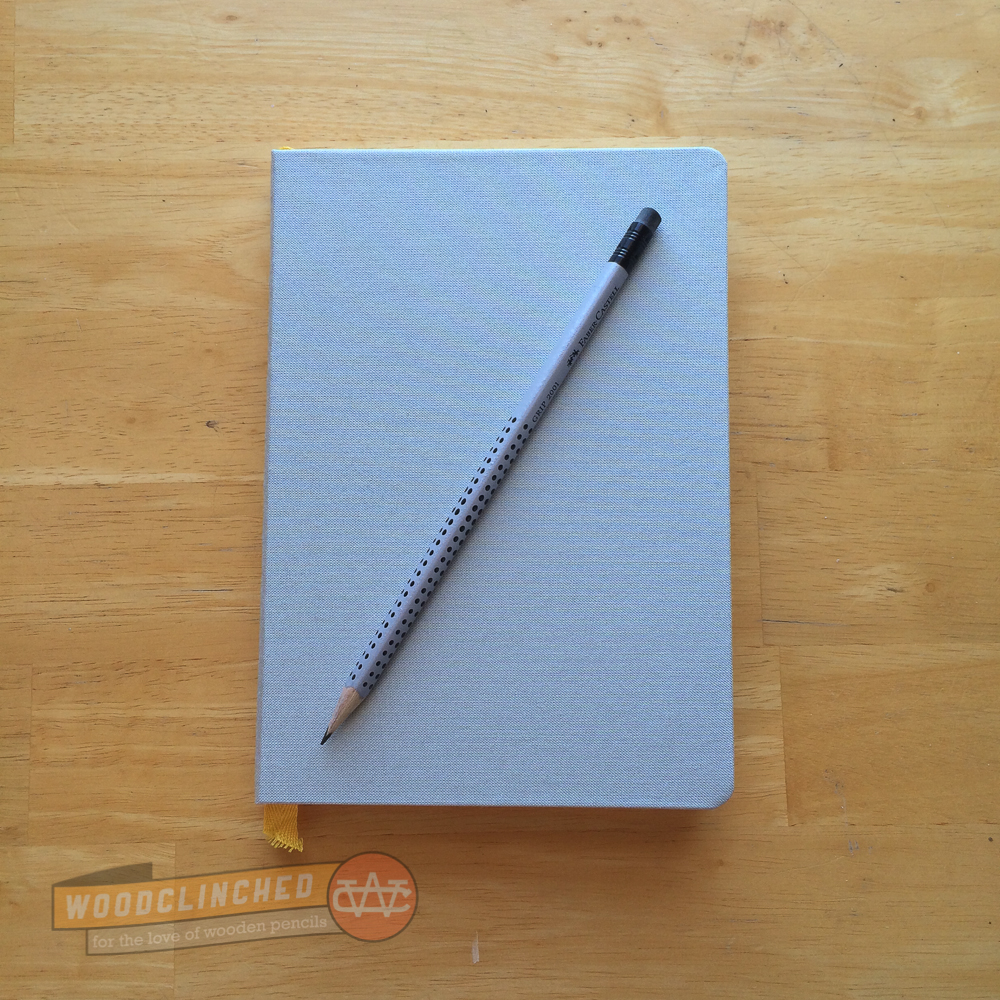
Baron Fig Notebook with Faber Castell Grip 2001 pencilI’ve had my Baron Fig Confidant for a little over a month now, and it’s definitely taken me this long to really figure out how I feel about it. In that time, I’ve gone from glee, to disappointment, and back to a medium-to-high-grade satisfaction. I think I’m ready to discuss it now. Meanwhile, there are a bunch of bloggers out there who have posted reviews much earlier than I have. Here’s just a partial list:

The look

Man, is this thing good looking. I’ve been posting some pictures of it, and even my non-scribomechanically oriented friends have mentioned something along the lines of, “wow, what is that?” It arrived in a vibrant, winey mauve box which fit it perfectly. Unboxing it was like opening a really nice piece of electronics, like an iPhone or a Kindle. The neutral, simple grey cloth cover is perfect. It reminds me of an aluminum MacBook — sleek, attention-getting, but subtle.

The Baron Fig Notebook comes in a beautiful, well-fitting box.

The Baron Fig Confidant notebook comes in a beautiful, well-fitting box.

The Baron Fig Notebook's gray cloth cover is tucked neatly behind the board that makes up the inside cover.

The gray cloth is tucked neatly behind the board that makes up the inside cover.

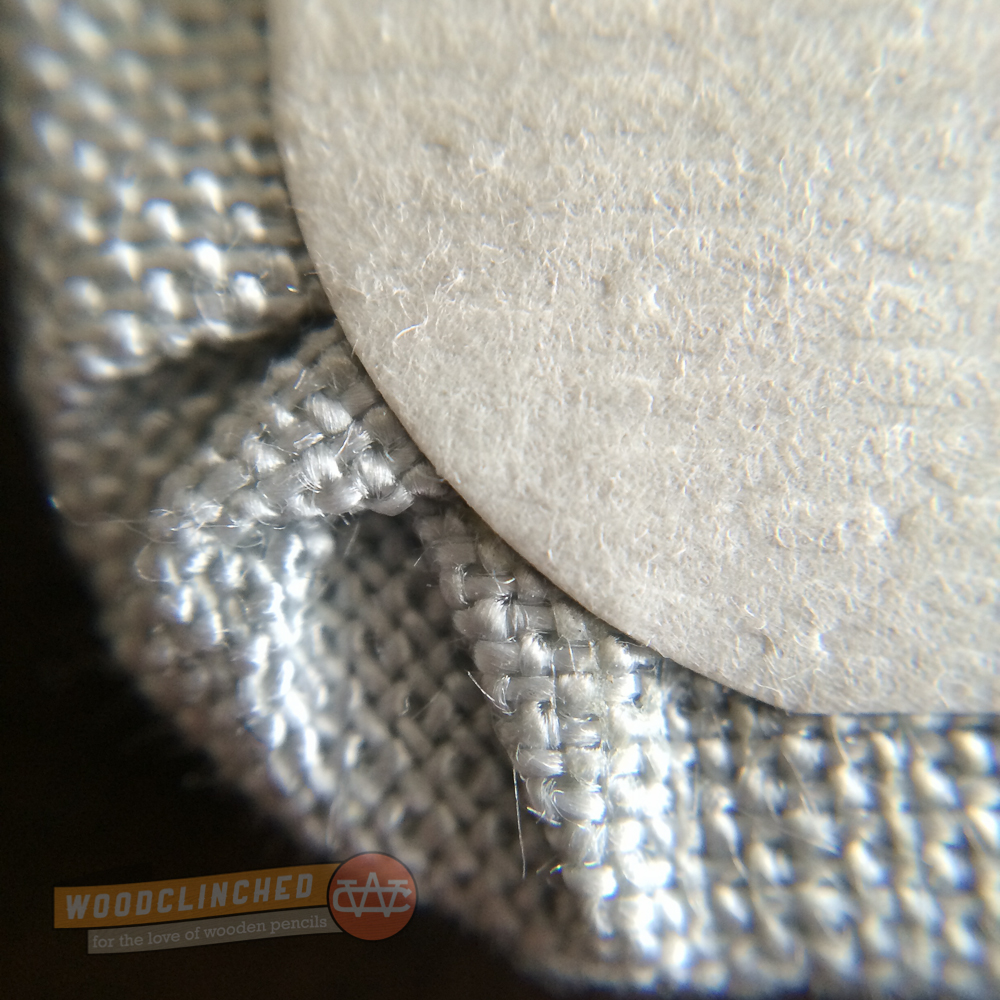
It’s stretched across the cover with no wrinkle whatsoever, and tucked neatly around the rounded corner behind the inside cover. There’s a gorgeous grey rolled linen paper behind each cover, and the one in the front has a simple box for your title.

(Baron Fig is currently running a social media campaign called “What’s in your box?”, where they’re asking users to share creative things they’ve drawn or written in their page-one box. Check out the Twitter hashtag #FigBox to see some fun examples.)

One of the great little flourishes on the Confidant is the canary yellow bookmark that comes with the notebook.

One of the great little flourishes on the Confidant is the canary yellow bookmark that comes with the notebook.

One of the great little flourishes on the Confidant is the canary yellow bookmark that comes with the notebook. It seems like almost every review expressed disappointment in the execution of the bookmark, though — it starts fraying immediately. Mine is no different.

Baron Fig Confidant notebook bookmark frays almost from the start, however.

The bookmark frays almost from the start, however.

Something I really like about the notebook is its size. At 5.4” x 7.7”, it’s a bit shorter and wider than, say, a Moleskine, it’s tweaked just a little bit, and while it’s not necessarily immediately noticed, with time, I really appreciated it.

The performance

As I mentioned in a previous post about this notebook, there’s a lot of hype to live up to. In the Kickstarter, the creators of the notebook made all sorts of claims — apart from the high-minded ideals of idea creation, inspiration, etc. — about it’s performance! It lays perfectly flat! No bleed on the paper! Does it actually do those things? Mostly.

Does it lay flat?

I’m definitely not an expert in bookmaking, but it seems like the notebook is made of more folios and signatures than a typical notebook. That means there are more opportunities for the notebook to be open toward the middle of one of those signatures, and therefore allowing it to stretch out. (Book binders: please correct me if I’m wrong!).

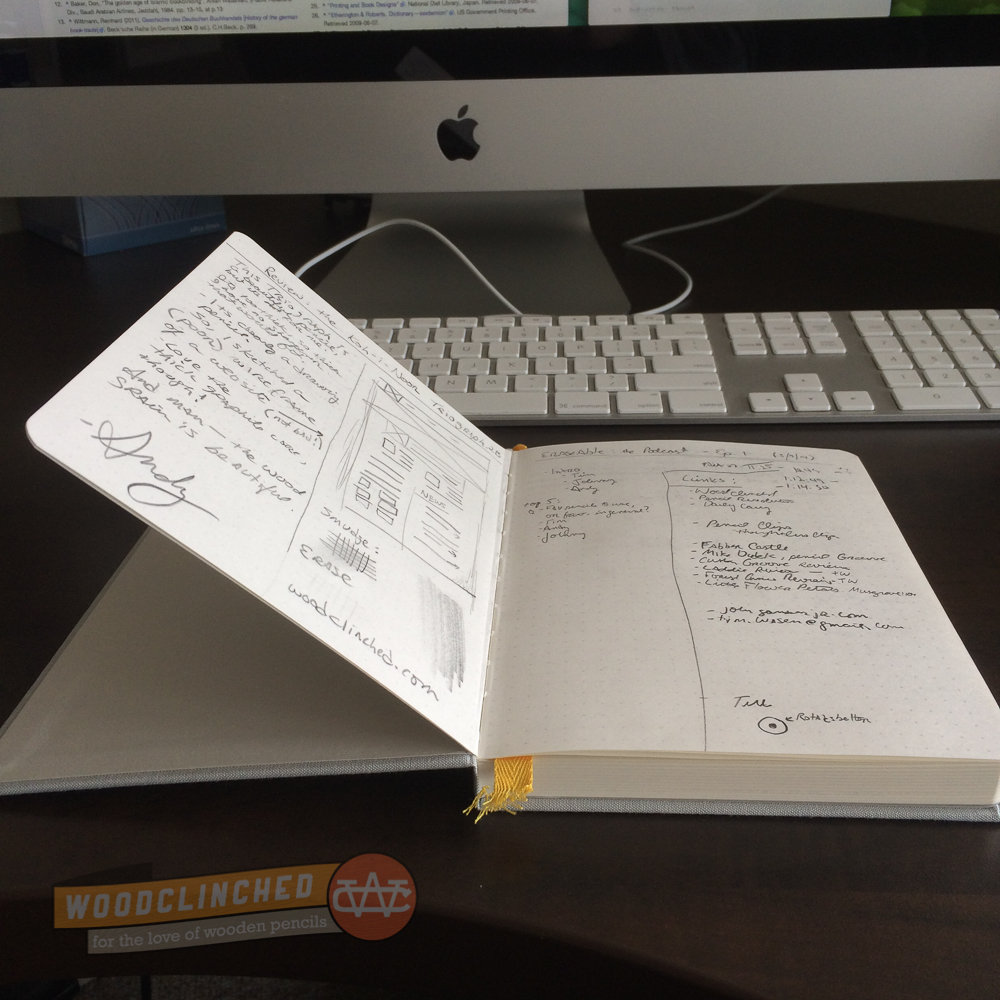
The Baron Fig Confidant notebook doesn't lay perfectly flat, but reasonably flat

The Baron Fig Confidant notebook doesn’t lay perfectly flat, but reasonably flat.

I’m still toward the beginning of the notebook — I only have maybe 10 pages or so filled up. These pages, though they don’t lay perfectly flat, lay way flatter than other notebooks. One of my Moleskines wouldn’t lay flat like this even with a pencil weighing down the page. Once I get a few more spreads in, though, it looks like it will start laying much flatter.

One issue: it’s hard to keep the notebook closed! It would really benefit from a band to go around the cover like a Rhodia Webnotebook or a Moleskine. Typically it’s not too much a problem, because it mostly lives inside my messenger bag where it’s held closed, but for those who keep it on their desktop, it might be a bit unwieldy.

Finally: as one reviewer mentioned (I’m sorry; I can’t remember who), this notebook is creaky! The spine feels very solidly constructed; even with the full weight of my hand resting on it, it doesn’t tear or crack. But sometimes it sounds like it’s going to.

Does it bleed?

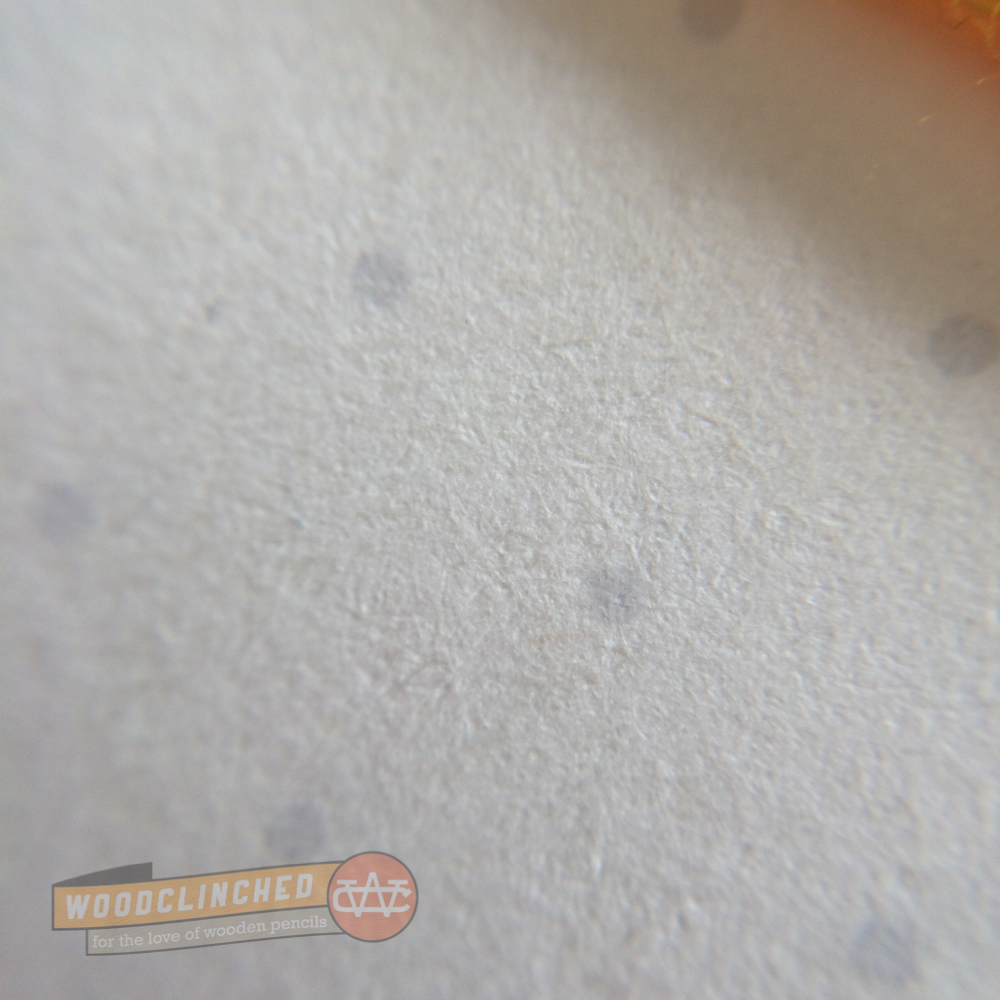
A close-up of the Baron Fig Confidant paper, with the dot grid. The paper is thick, not too toothy, but not too slick, either.

A close-up of the Baron Fig Confidant paper, with the dot grid. The paper is thick, not too toothy, but not too slick, either.

This paper is nice. It’s definitely heavier stock than a Moleskine, though maybe not as heavy as the 70# stock in the Field Notes Shelterwood. Maybe a 60# or 50#?

Paper test for the Baron Fig Confidant notebook

I gave the page a good test with a few kinds of pencil, a fountain pen, a roller ball, a felt-tip and a Sharpie. The fountain pen, with a medium nib, had a tiiiny bit of visibility on the opposing page, and the thick, chisel-tipped Sharpie definitely bled through, but everything else held strong.

The felt-tip and the fountain pen are barely visible on the opposite side of the page.

The felt-tip and the fountain pen are barely visible on the opposite side of the page.

But the chisel-tipped, thick Sharpie bled through badly.

But the chisel-tipped, thick Sharpie bled through badly.

I think this is a solid mark in their favor. Since I’ll primarily use pencil, I should have no problems at all.

And speaking of paper…

Dot-grids, though

I ordered the dot grid configuration (it’s available in blank and narrow-ruled format, too), thinking it’d be really similar to a traditional grid, which is my preferred paper format. Man, did it take some getting used to!

At first, I could have sworn it was a smaller grid than a standard grid layout. When I would write, I would bump up agains the line above, and the ascenders and descenders would crowd out those on the adjacent lines. It didn’t seem like I was writing too big. I measured the space between the dots — five millimeters.

Surely it was too small; five millimeters was definitely not enough for a line of my handwriting. I was ready to abandon the Confidant.

But then I measured the space in a Rhodia notepad grid — the grid of perfection, in my opinion — and that of a Field Notes Drink Local edition. Both of those measured the same five millimeters!

What, then? Why does it feel so drastically different in this notebook?

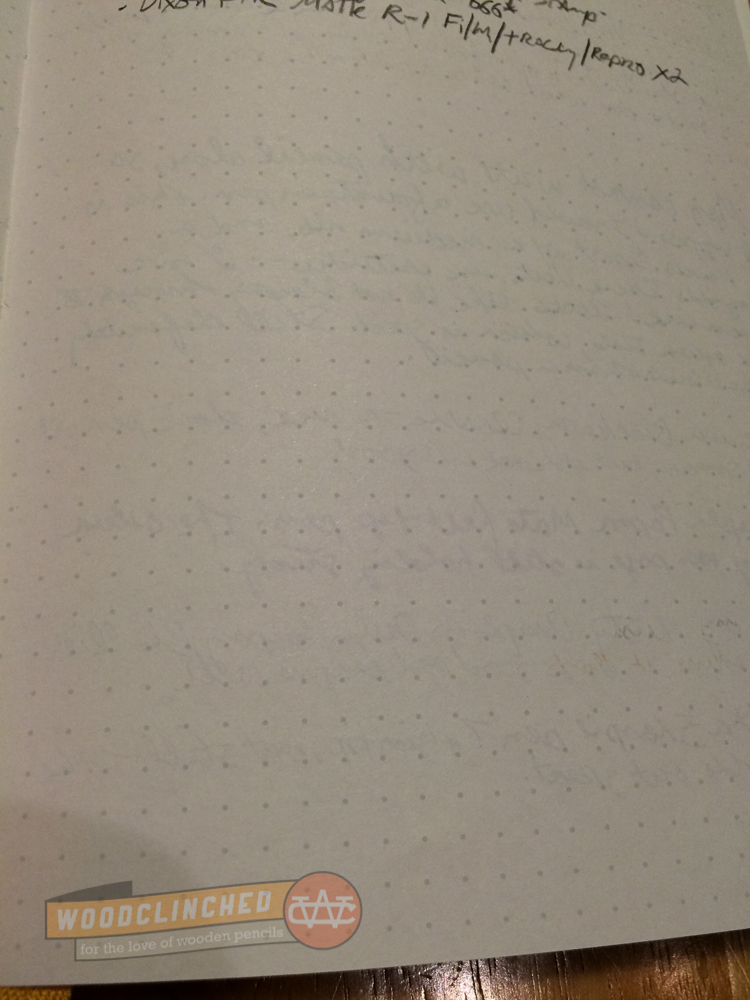
Baron Fig Confidant notebook handwriting closeupI came to the conclusion that it’s the dot grid. I can’t use a blank page for writing without some sort of guide, because my hand wanders all over the page. Both the lined and the gridded paper keeps my writing in check by giving my hand a literal baseline to follow. The dot grid only kinda sorta did that.

Though my hand encounters the dot every couple of letters or so, I think it’s not substantial enough to really guide my writing in straight path.

Bottom line: I love the look and feel of the dot grid. I’m definitely not going to give up on it; I think I just need a little bit more experience to train my writing.

Recommendation

For $15.95, this notebook is well-priced for the quality and unique look and feel you get. And if you love writing in an A5-sized notebook, like a Moleskine or a Rhodia Webnotebook, you’ll love this.

It’s not perfect, but as they claim on their website, the product is ever-evolving: they will tweak their next run based on user experience and feedback. The notebooks they sell two years from now might be completely different!

Pick it up at BaronFig.com.


My father-in-law’s old notebooks

My wife and I recently stayed at her parents’ house for a few days while the first floor of our place was being re-ceilinged. While a disruption in one’s life like that is never particularly fun, I did enjoy a change of scenery—there’s something that can be reinvigorating in changing the stuff that surrounds you. I was amongst a collection of belongings accumulated over decades, but weren’t our belongings.

This fact was never as apparent as when I closed myself in my father-in-law’s office to record Episode 3 of Erasable (have you heard it yet?).

My father-in-law reminds me a lot of Ron Swanson from Parks & Rec. He’s very libertarian, fairly private and extremely independent. He’s a civil mechanical engineer by trade with lots of interesting hobbies—he builds boats, he makes wine in his basement and he collects antique guns.

And while not an official collection, he has lot of interesting notebooks—old notebooks—laying around.

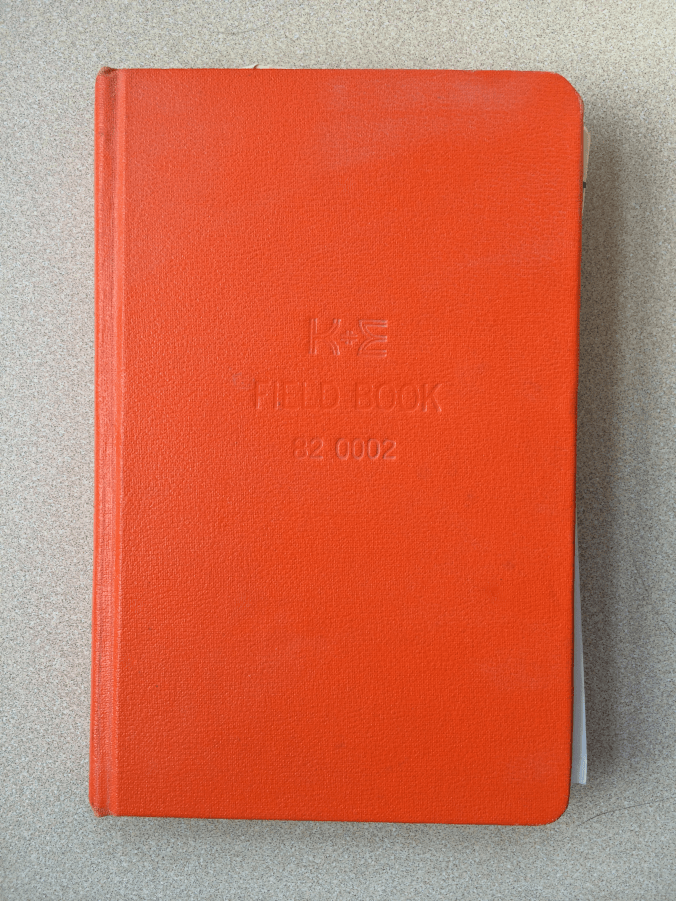
Keuffel & Esser Field Book

My favorite is this one, which caught my eye right away:

K&E Field Book by Keuffel &  Essel

K&E Field Book by Keuffel & Esser

Look how cool this is! Made by Keuffel & Esser, a US-based drafting instrument and supply company. It was founded in 1867, the first of its kind in the US, and lived on until 1987 when it was bought by the AZON Corp in 1987.

So this notebook is at least 27 years old, right?

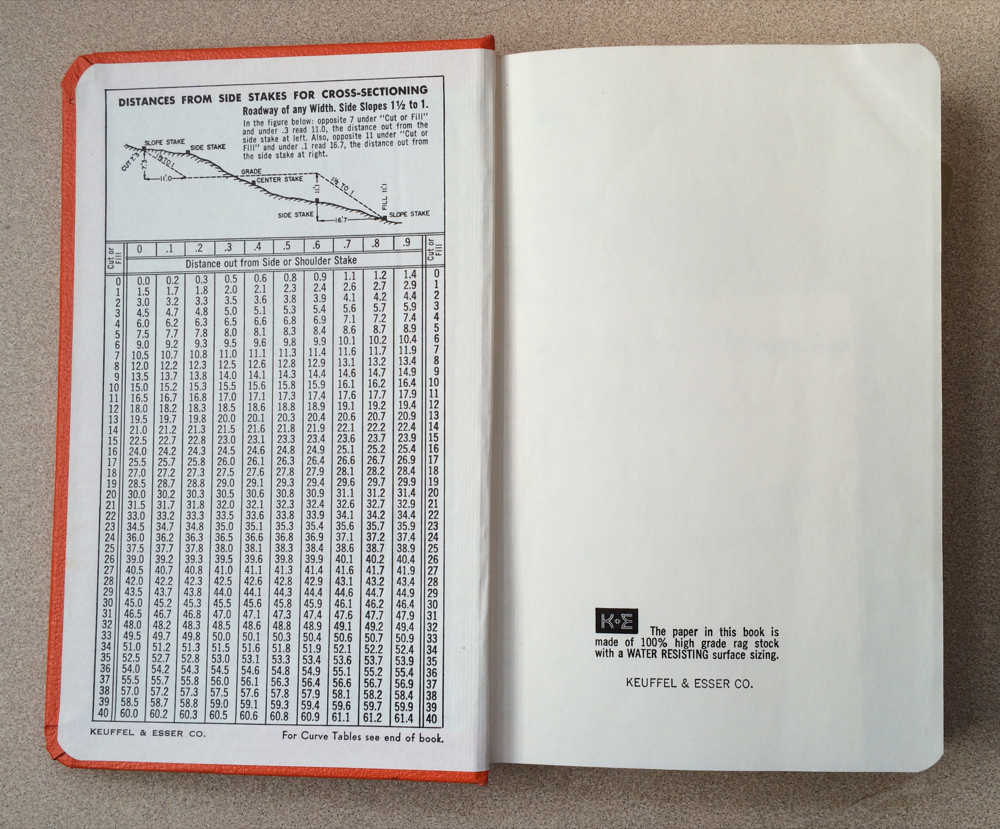
Let’s look at the inside cover: orange-open

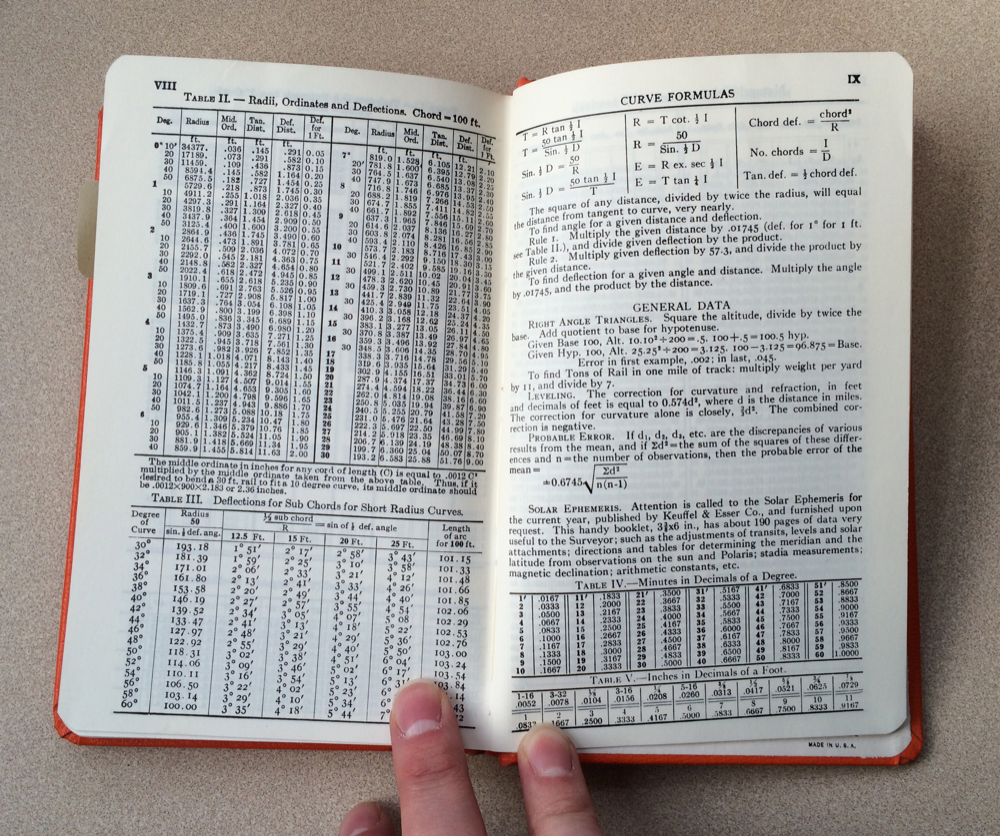
This A5-ish notebook is filled with data tables, formulas, conversions, and other useful data for engineers. I can’t imagine how handy this kind of thing would have been to someone like my father-in-law in a day before this information was available through a smart phone. Some more reference goodness from the back of the notebook:

orange-formulas

The back pages of the Keuffel & Esser Field Book are filled with data tables, conversions, formulas, and other information an engineer would find useful. Forgive my fingers in the shot — this book has difficulty staying open.

My favorite thing about it? The grid paper:

Keuffel & Esser Field Book grid

I’m not entirely sure of the particular function of this paper (a coworker suggested it’s for lots of tabular data, much like an Excel spreadsheet is now), but the grid on the left is separated into six columns by pink lines, which I believe are three times wider than the horizontal line hight. The right side of the spread is separated into two columns by a pink line, with smaller vertical blue lines that make a grid that’s twice as tall as wide.

Boorum & Pease Memo Book No. 6565

As I mentioned earlier, my father-in-law built a boat. We all thought it was an improvised affair; with PVC pipes lashed to two-by-fours and duct tape. But he’s apparently been planning it for quite a while. In fact, he has a whole notebook where he planned it out and documented his project:

Boorum & Pease Memo Book

Boorum & Pease Memo Book

Boorum & Pease Memo Book

I blurred out my father-in-law’s name because I assume he wouldn’t want to that out floating around on the internets.

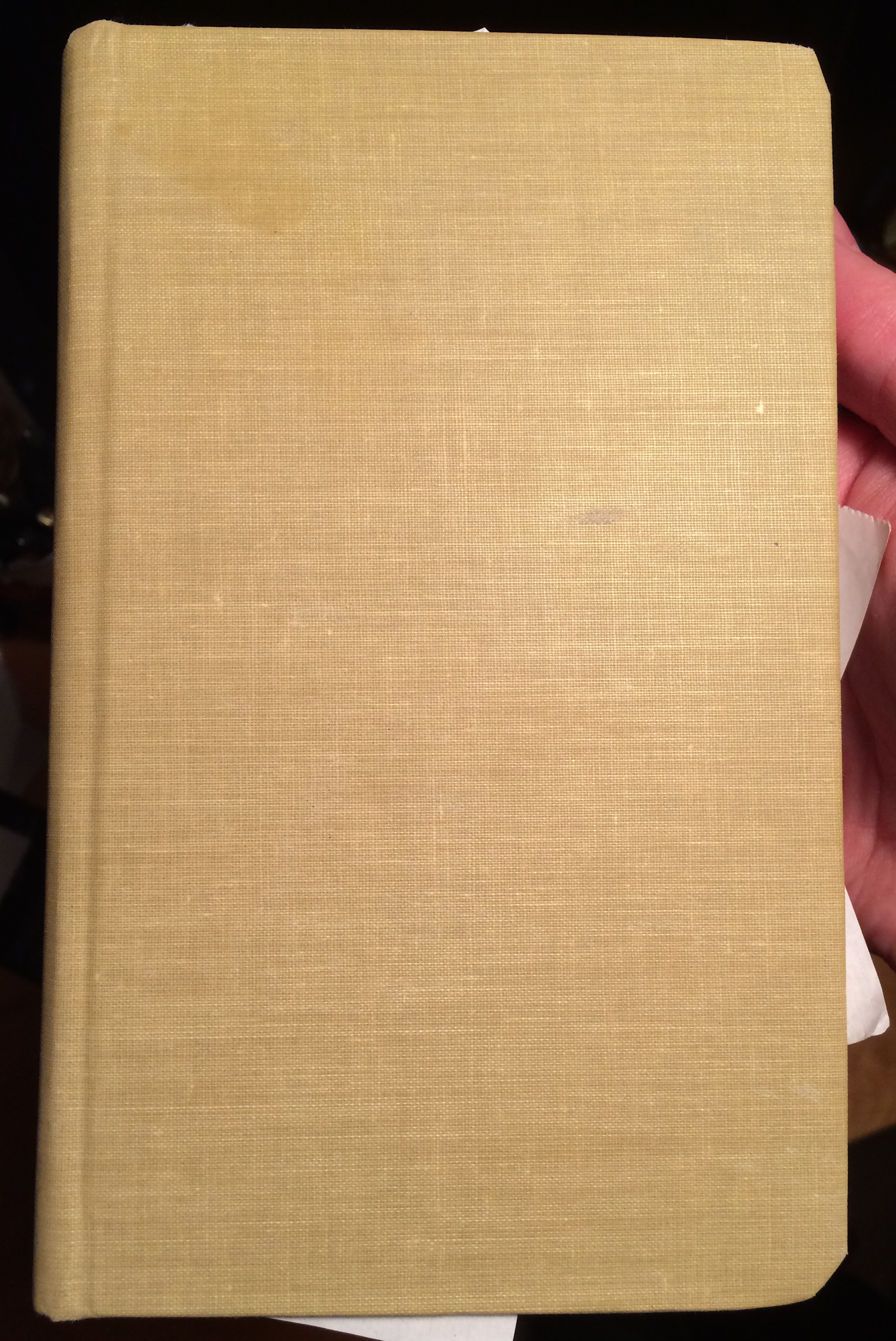
Boorum & Pease adThis notebook is branded with the “Boorum & Pease” name, which sounds to me like something Click and Clack from “Car Talk” would come up with. The Boorum & Pease Co (Blank Books and Loose Leaf Devices) has been around since, it looks like, the 1870s (as this 1904 ad boasts, “for more than half a century”). They sold specialized notebooks for laboratories, ledgers for accounting, receipt books, et cetera.

Boorum & Pease memo book lined paper

A close-up of the cloth binding on the Boorum & Pease memo book.

A close-up of the cloth binding on the Boorum & Pease memo book.

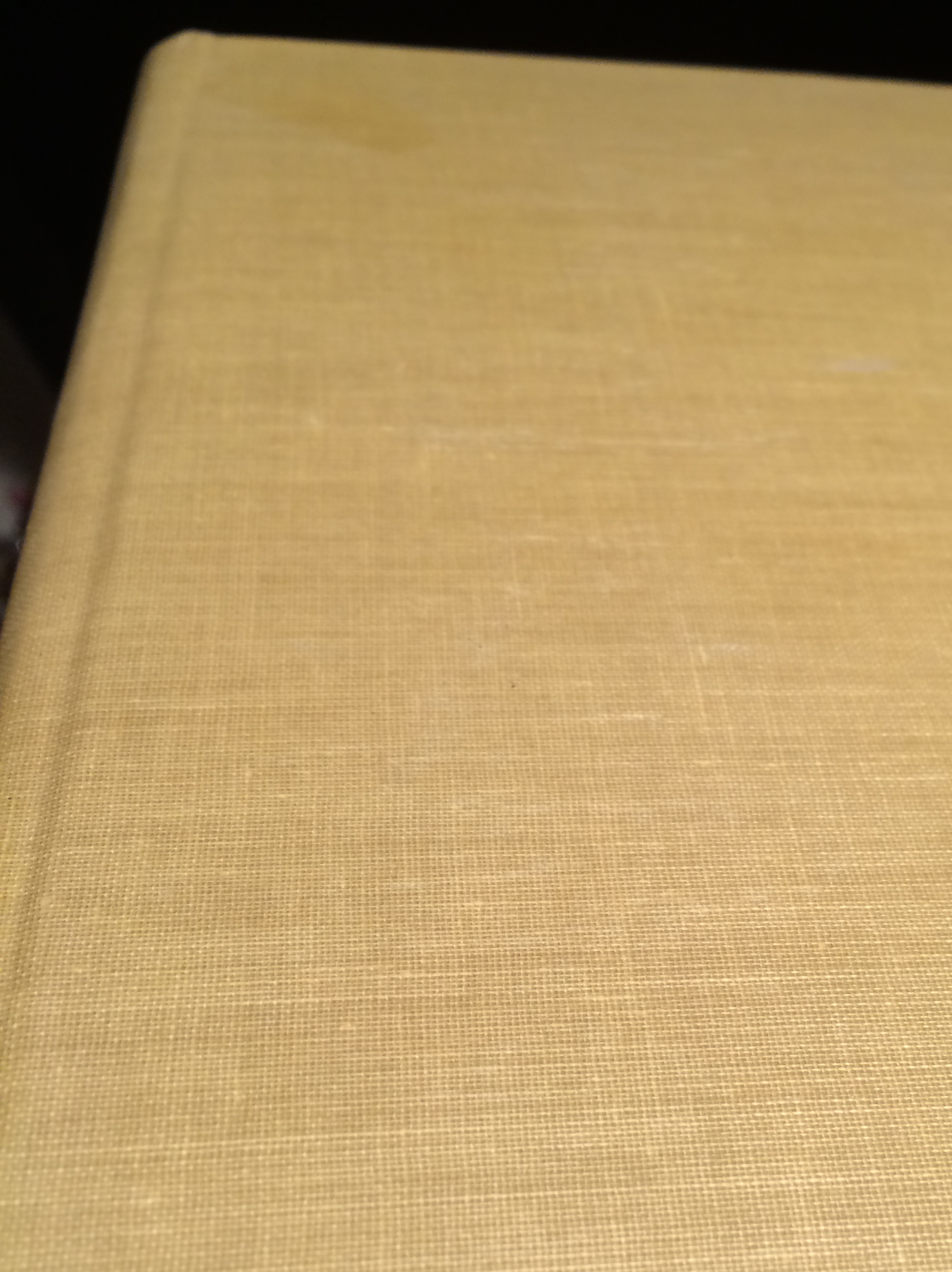
I’m a fan of the binding on this book — it’s cloth-bound, reminescent of old, mid-20th century hardcover books. How handsome would the cover be with a big foilstamped signet or simple illustration?

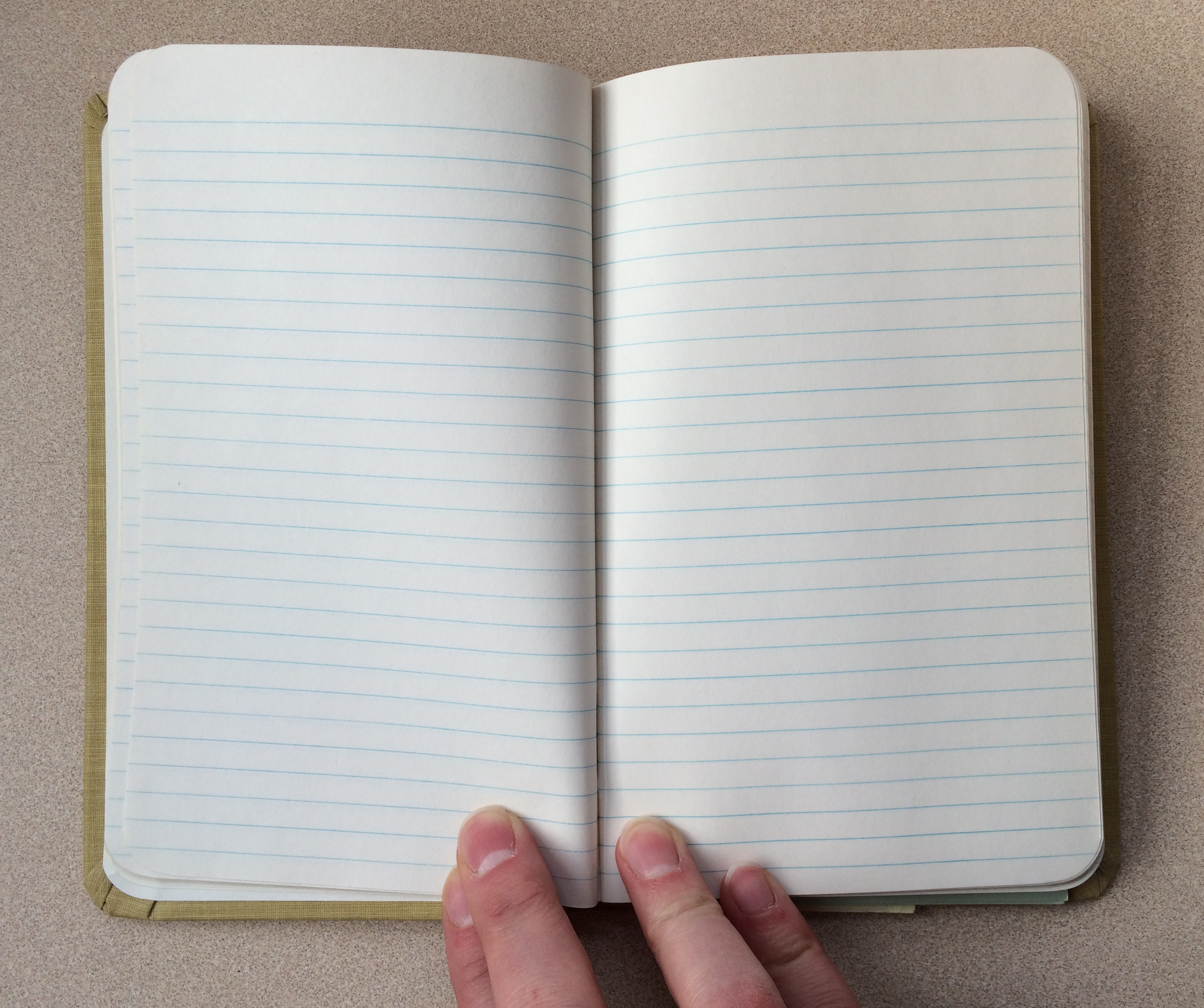
The paper is nothing to write home about, but it’s a nice, plain college-ruled page. It’s thin, but not too thin. Since this isn’t my notebook, I wasn’t able to test it with pencil and fountain pen, but I imagine it might handle a dry to medium fountain pen without too much bleeding.

In fact, the still around, though it’s unclear to me who owns that brand name. I don’t think they are their own company. They still make columnar books (kinda gaudy looking, if you ask me), and while this particular model is not still in production (#6565), they still make something that looks reallllly close, #6559. I doubt it’s cloth-bound, though.

Here’s a pretty great history of Boorum & Pease by Walter Grutchfield.

Other old vintage memo books

I’ve seen lots of great memo books like these over the years that just seem like they’re made better than your typical notebook serving similar purposes. Sure, there are small independent ventures that produce great ones now, but these were in mass production, and no doubt costed much less than indie craft notebooks now.

Do you have any interesting ones to share?

The Koh-I-Noor Triograph: The Sharpie of pencils

The Koh-I-Noor Triograph

I finally got my hands on a pencil that I’ve liked for a long time — the Koh-I-Noor Triograph. I fully realize that it’s not a writing pencil, but a sketch pencil. From the Koh-I-Noor website’s product page:

These 5.6mm lead pencils are excellent for working in large areas and for quick, loose strokes; they blend extraordinarily well too.

They can be used alone or in combination with a plethora of artistic media to achieve effects as unique as the individual artist.

That’s a little fancier that I get, folks. But man, they’re gorgeous. I love the stain on the wood barrel:

Closeup of the Koh-I-Noor Triograph tipCloseup of the Koh-I-Noor Triograph barrel.

I also really like triangular barrels. That was definitely a big decision factor for me.

So when my pencils arrived from Jetpens (Disclosure: I received these pencils at no charge for review purposes), I opened then excitedly. Continue reading