Review: the Helix Oxford Premium Grade HB

Editor’s Note: I  originally wrote this review for the now-defunct PencilThings.com blog in May, 2007. See the bottom for an update written yesterday.
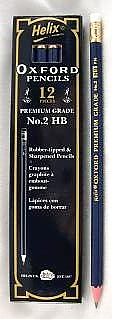

Helix Oxford Premium Grade HB

Being an anglophile, I appreciate all things British. I love loose-leaf tea, Doctor Who, Crispix crackers, not pronouncing the letter “H,” among others. So when I read that Pencil Things introduced a UK pencil not found in the US, I jumped.

And for the most part, I like it. Let’s talk about the aesthetics first, since that is what initially attracts buyers. I don’t dig the pink wood. The navy veneer and the white eraser look good, but the red-hued wood just doesn’t go. It doesn’t even smell good, like the incensed cedar so many fine pencils use.
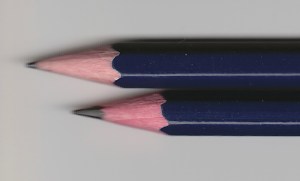
I've heard rave reviews about the pink-hued wood on this pencil, but it just doesn't do it for me.

One positive thing about the wood, though, is that it sharpened really smoothly. Although my sharpener was bought from Target, it was like cutting butter with a knife.

Kudos to the graphite, though — it stayed sharp and although it initially left a fine dust on the paper after pressing the newly sharpened point to the paper, it held its sharpness like a champ.

As the product description says, the eraser lacks the pumice-like quality of the pink variety, and I think  that may be a step in the right direction. It erases clean and smoothly, and doesn’t leave grit in its wake. (Plus, I think it looks nicer.)

Speaking of erasers, I think it is brilliant that the eraser is removable and replaceable. Just give it a firm tug and it pops right out. Although I don’t make too many mistakes when writing (being a pen user before I was converted to graphite), my handwriting is atrocious, and I often have to erase and write more legibly. I always run out of eraser before running out of pencil.

I also wonder if any British people out there can explain this to me — There is a large barcode imprinted on the side of the barrel. Why is that? I own a pen bought at an office supply store in England with the same thing on it. Can’t you put it on a sticker, so as to peel the unsightly barcode off after purchase?

UPDATE Sept. 15, 2010: I tried one of my Helixs on a Rhodia notepad (known for its really nice, smooth paper) in a side-by-side comparison to a Dixon Ticonderoga, often considered to be the iconic standard pencil. I thought it fared well:
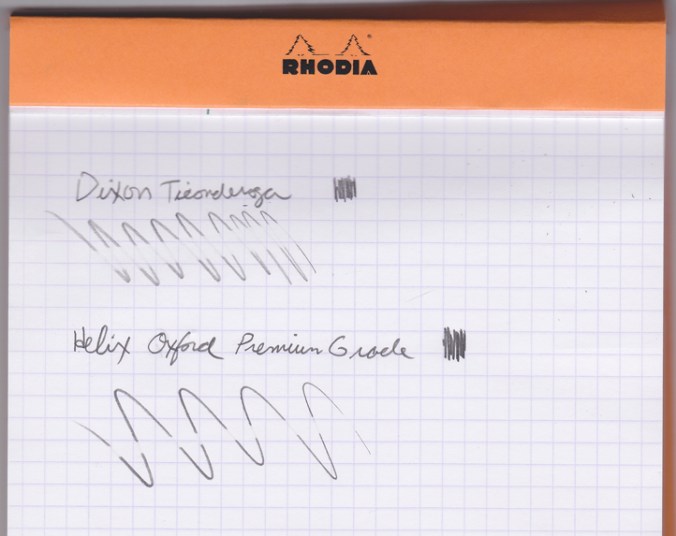
As you can see from the picture above (click to embiggen), the Oxford was a hair darker and more consistant than the Dixon. The square that I filled in with a dark line was darker, and the graphite erased better through the squiggle.

At the time of this posting, it seems the only place you can buy this pencil around the US is at PencilThings, and they are out of stock. You might want to contact the good people at the US distributor for Helix, HelixUSA.

Economics of pencils

As you may or may not be aware, California Cedar is reviving the Blackwing brand! The pencil community is all astir with excitement about it. Building up to their release, CalCedar’s Charles Berolzheimer (or “Woodchuck” as he is known on his blog) is writing a series of posts about the “why” of their decision to lead up to the product release. While I try to figure out how I’m going to do a video review of my new strange pencil sharpener, I think I’ll discuss the first of these articles.

In his first article, “Why Take on the Challenge?“, he almost seems like he’s trying to talk himself out of it:

Anyone crazy enough to try to build a new brand name in a rough and tumble globalized commodity business like the pencil industry is always going to want the best advantage possible. Very few pencil producers really professionally and effectively advertise and market pencils anymore. The closest promotion the average consumer is exposed to are circular ads of mass retailers and office superstores offering “loss leader” prices during back to school time to get people in the door. They’ll give away $2 of pencils at or below cost to sell that $10 to 20 calculator and other goods that makes them much higher margins. The cost pressure from the large retailers drives producers towards an obsessive focus on the economics of pencil production. Over the last 20 years, this has resulted in a reduction in the general quality of pencils and outsourcing overseas while cutting marketing support dollars and manpower devoted to thinking creatively about pencils. [link]

This is really interesting, and so true. Office Depot sells a dozen plain yellow pencils for about the cost of a single CalCedar Palomino pencil, so most consumers would go out and buy the Office Depot brand, right? Not many people, it seems, see a quality difference that would justify the cost of a Palomino, although they are worlds apart to me.

This article linked to a past Pencils.com article about the economics of pencil-making. This was interesting, too, although it was more of a list. It did reference an old, fairly famous essay by economist Leonard Read called I, Pencil, where he discusses the globalization of something even as straightforward as a simple pencil.

I, Pencil, simple though I appear to be, merit your wonder and awe, a claim I shall attempt to prove. In fact, if you can understand me—no, that’s too much to ask of anyone—if you can become aware of the miraculousness which I symbolize, you can help save the freedom mankind is so unhappily losing. I have a profound lesson to teach. And I can teach this lesson better than can an automobile or an airplane or a mechanical dishwasher because—well, because I am seemingly so simple.

Simple? Yet, not a single person on the face of this earth knows how to make me. This sounds fantastic, doesn’t it? Especially when it is realized that there are about one and one-half billion of my kind produced in the U.S.A. each year.

The article was written in 1958, so the statistic at the end of the quote may be a bit different.

Anyhow, to get back to the crux of WoodChuck’s article: if pencils are a globalized commodity, land where price- and quality-slashing is king, how do you manufacture and market a high quality, fairly expensive (I’m assuming) product?

I think he has the answer. After all, he’s been doing it with the Palomino brand all along.

Since we launched our California Republic range my vision has been to establish our premium quality Palomino brand as fresh, new and fun, with great quality and safety performance. This has been a gradual and experimental process mostly conducted over the internet and in my spare time when not attending to our core slat and firelog businesses. Nevertheless we are building a small, but growing fan base and our recent Pencils.com website redesign is helping to move this ball forward with our “Freedom of Expression” theme as well as expanded features and products. In our view the pencil is perhaps the most common and affordable tool of creative self-expression used around the world. It may not have the reach of the internet, but there is a personal sense of connection to writing, drawing, sketching or doodling with a pencil that for many cannot be matched by typing on a keyboard or drawing with a stylus on a computer screen. For us, Palomino is an important part of enhancing “freedom of expression”, but we know finding your favorite instrument of self-expression is a personal journey and so in time we’ll be featuring even more pencils from other producers who use our slats in our store.

They are accomplishing a few things here:

  1. Creating an online community of pencil enthusiasts to ooh and ahh over this product line,
  2. Highlighting quality of materials and manufacturing over inexpensiveness,
  3. Championing the pencil as a tool of self-expression and creativity, rather than a blah stick of wood you use to take notes or do boring business-y things, and
  4. Making it personal — offer choices as part of a “personal journey”.

It works for me. Admittedly, these are the conclusions I came to on my own before ever hearing of the Palomino or any of the other California Republic brands. It seems obvious to me that the writing experience of a Palomino (with the highly lacquered barrel, incensed strong wood, hearty but effective eraser, and smooth and dark lead) trumps a cheap feeling Office Depot pencil any day. But there are some people who must be convinced.

Is it wrong to buy cheap pencils when they could be paying more for an experience? Well, I don’t work for CalCedar, so I say no. Is it wrong for someone to prefer Tang when they could be drinking fresh-squeezed orange juice? I may try to convince them to pay the price for a pencil as an experience rather than a tool, but I don’t think it is intrinsically wrong if that’s not how they feel.

I look forward to hearing more about preparation for the Blackwing’s re-release. Meanwhile, head over to the Pencils.com blog or WoodChuck’s personal blog, Timberlines and stay up to date with news, editorials and features. And if you haven’t ever used a Palomino or any of its kin, buy one from the Pencils.com store. It’s an experience. (I’ll be waiting for my commission check!)

A realist’s review of the legendary Blackwing 602

UPDATE 8/25/10: I just found out that California Cedar has bought the Blackwing trademark and is reissuing it under the Palomino brand! This is super-exciting news. Check this out for pictures. Oh, and if you’re from CalCedar, drop me a line. 😉


NOTE: I wrote this way back in September 2007 on a pencil blog I contributed to, a service of PencilThings.com. Unfortunately, that blog is now defunct as the site got sold, I wanted to repost it here. It was reblogged by a few other sites, most notably BoingBoing, which led to around 10,000 hits in a matter of hours.

The rectangle ferrule and replaceable eraser, a Blackwing 602 signature. Picture from PencilPages.com.

I’m sure those pencil enthusiasts out there know what I’m talking about. It is the Holy Grail of Pencils. What the DeLorean is to cars, is what the Faber Castell Blackwing 602 is to pencils. It’s the hard-to-find, insanely-expensive, out-of-production pencil.

And many people out there give it a perfect 10 rating.

A popular review of the Blackwing, which has captured the attention of such sites as Boing Boing (here and here) is pencilpages.com’s review, “The Blackwing 602 – Final Chapter.”

An excerpt:

“What is so special about this pencil that its devotees will accept no substitute and make them willing to spend $250.00 for a box of them? It has a sleek and unique design, and if you’ve ever used one, you know it is a very smooth-writing and easy to use pencil. Its famous slogan “Half the Pressure, Twice the Speed” is no exaggeration. It is also the last of a line of pencils featuring a distinctive rectangular ferrule with a unique, replaceable eraser. I am no artist, but I know that professionals rely on quality and consistency in the tools they use, and the Blackwing was one that could be relied upon.

The Blackwing was originally manufactured by Eberhard Faber. When Faber-Castell USA (F-C) bought Eberhard Faber (EF) in the 1980s, the pencil continued production with the E-F name, but some were also produced with the F-C name on them. Either way, the pencils were made with the same 4B lead formula. During the 1990s, the company was bought by Sanford Corp., one of the world’s leading manufacturers of writing instruments of all kinds. Sanford is also the owner of the Paper*Mate and Berol brand names, as well as many others.

The Blackwing continued in production until 1998 and has not been made since. It was originally reported that production ceased because the machine used to make the unusual ferrule broke down and the company did not want to fix it. This is not the entire story. In June 2004 I met with personnel at the factory where the Blackwing was last made and got the real scoop.”

Click the link to read the rest of the story.

I took the financial plunge. I got on eBay, scoured around, got aggressive with my bidding, and scored a Blackwing. I will admit, it is a nice pencil. Maybe the nicest I’ve used before. But it certainly isn’t worth $25.

First, the graphite. The slogan “Half the Pressure, Twice the Speed” is true enough. It feels like there is a high amount of wax in the lead to make it just glide across a piece of paper, but the line is dark and significant, which is usually indicative of a harder, rougher element. I was impressed.

Understandably, the eraser is old, as the pencil I bought couldn’t be any newer than 10 years. The commodity of being able to take the rectangular eraser out and turning it over, though, improved the performance — I just used the side that hasn’t hardened with exposure to air. The shape is innovative, and gives a good wide angle with which to erase effectively.

One thing I like about it is the extreme glossiness of the paint coating the barrel. Even jostled around in my aforementioned various pencil boxes, the patina never got dinged, scratched, or otherwise blemish the Blackwing. It looks good, a bit like a shark with its not-quite-gray, not-quite-brown coat.

A positive review all around. I am impressed with the performance of the Blackwing. I might pay $5, or even $10 per pencil, but $35-$40 per actual pencil? I think not. Recently, eBay had a lot of 144 Blackwings, and that sold for about $1400. I almost bid on it, thinking that I could then make a fortune by splitting up the lot and selling individual pencils. But I stopped myself — I love pencils, don’t get me wrong — because I couldn’t bring myself to make a major (for me) investment in this particular writing instrument.

One of my joys of pencils is the fact that they’re cheap. Even top-quality products like California Republic’s various pencils aren’t any more than a couple bucks apiece — and that’s at the higher end. If I go out and splurge on a couple unique pencils for my collection, my wife isn’t going to get mad. I’m not collecting antique fountain pens, after all.

I think that maybe the Blackwing’s hype is super-inflating the price. Its extremely high quality performance has been expressed by writers and artists alike, and sites like BoingBoing and other lesser meme-spreaders caught on. That’s certainly how I heard about it. Like Tickle-Me-Elmo and, most recently, the iPhone, the Blackwing is legendary in the world of scribomechanica enthusiasts.

My recommendation is that if you are serious about your pencils, and you want one, just go ahead and buy one. It’s worth the experience, and in the bigger scheme of things, it isn’t too much. But don’t use it often, and treasure it. For your daily writing, use something else, something cheaper. Break out the Blackwing when you want to start a conversation.